Bali digital nomad visa: your options in 2026
There's no visa called the "digital nomad visa" in Indonesia. There's a remote-worker visa, three kinds of tourist visa that most nomads actually use, and a tax rule that matters more than any of them. Here are the options as they stand in September 2026, with fees from the immigration directorate's own pages, and a note wherever the rules are grey. Once the paperwork's sorted, the villa office guide covers the part nobody writes about.
Checked September 2026 at about Rp 17,600 to the dollar. These are the official government fees; agents charge more. Immigration rules move, so re-check before you rely on a number.
The short version
| You want to stay | Use | Official cost | Notes |
|---|---|---|---|
| Up to 60 days | Visa on Arrival (e-VOA) | $28, plus $28 for one 30-day extension | 97 nationalities; the extension needs an in-person visit |
| Up to 180 days | C1 tourist visa | $57, plus extension fees | Apply online before you fly; extensions in person |
| Coming and going for years | D1 multiple-entry tourist visa | $170 / $284 / $568 for 1 / 2 / 5 years | 60 days per entry, extendable to 180 |
| A year, working for a foreign employer | E33G remote-worker visa | $398 | Needs a foreign employment contract and $60,000 a year income |
Visa on Arrival: the default for a month or two
Most nomads from the 97 eligible countries — the US, UK, EU, Australia, Canada, India and more — land on a Visa on Arrival. It costs $28 (Rp 500,000), gives 30 days, and extends once for another 30, so 60 days in total. Buying it online as an e-VOA before you fly saves the airport queue.
Two things changed recently. Since 29 May 2025, every extension, the VOA included, needs you to appear in person at the immigration office for the area you're staying in, for a photo and a short interview: you start online, pay, then go in. And in August 2026 the directorate announced a planned rise to $43 (Rp 750,000) for the e-VOA and $57 at the counter. The portal still charges the old rate as of this writing, so check the price when you apply.
What a VOA doesn't allow, on paper, is receiving any compensation for work. In practice, working on a laptop for an employer outside Indonesia is what tens of thousands of people do on one, and the deportations reported through 2026 involved people teaching yoga, taking influencer barter deals or volunteering, not people on Zoom calls with a company in Berlin. It's tolerated rather than permitted. If you're staying long, or your work is visible, the E33G below is the clean route.
The C1 tourist visa: up to six months
The visa older guides call the B211A is now the C1. You apply online before travelling, pay $57 (Rp 1,000,000), show a bank statement with at least $2,000, and get 60 days on arrival. It extends in 60-day steps to 180 days total, each extension following the same routine: start online, pay, then the in-person photo and interview. The extension fee sits between $57 and $114 depending on the office, and the portal shows the amount at payment.
Six months is where most people who say they "live in Bali" actually sit, and it's why our monthly rental packages exist. Three C1 extensions is three villa moves for a lot of people, and everything you've rented moves with you.
The D1 multiple-entry visa: for people who leave and come back
If you're doing Bali in blocks with trips out in between, the D1 is a tourist visa valid for one, two or five years at $170, $284 and $568, letting you stay up to 60 days per entry and extend to 180. Same $2,000 statement. It removes the reapplying, not the extensions.
The E33G: the only one that actually says you can work
Indonesia introduced the E33G in April 2024 and it's in force in 2026. It's a one-year stay permit for people employed by a company established outside Indonesia. From the official page, you'll need:
- an employment contract with a company outside Indonesia
- income of at least $60,000 a year
- a bank statement of at least $2,000 for the last three months
- a passport with six months' validity, a CV and a photo
- no local sponsor
The government fee comes to $398 (Rp 7,000,000) for the year, covering the visa, verification, the stay permit and a re-entry permit. Agents charge roughly double all-in, which is the price of not dealing with the portal yourself. It takes about five working days after payment, and you have to enter Indonesia within 90 days of issue. The official page says the permit is extendable; how many times, and whether freelancers without a single employer qualify, isn't published, so treat anything beyond one year as unconfirmed.
It doesn't cover working for an Indonesian employer, earning Indonesian-source income, or selling anything in Indonesia. And it isn't the E33F, which agents market as a retirement visa and which needs a sponsor and $3,000 a month, or the E33 Second Home visa, which now wants a $130,000 deposit in a state bank or a $1,000,000 property. The Golden Visa starts at $350,000 in bonds or shares. None of those is a nomad visa.
The 183-day rule
This matters more than the visa. Spend more than 183 days in Indonesia in any rolling twelve-month period — not a calendar year, and the days don't need to be consecutive — and you become an Indonesian tax resident, which means registering for a tax number and reporting worldwide income, subject to whatever treaty your country has with Indonesia. Holding a one-year E33G is itself evidence of intent to reside. Two C1 visas back to back with a short trip in the middle can cross the line without you noticing. If you're anywhere near 183 days, talk to an accountant who knows both countries before you get there, not after.
The tourist levy and the arrival card
Separate from any visa, Bali charges every foreign tourist $9 (Rp 150,000) per visit, paid online at the Love Bali site or at the airport counter. In 2026 the province started enforcing it properly: airlines announce it on every flight in, and there are spot checks at attractions. Stay-permit holders, E33G included, are exempt automatically. A rise to $14 or $28 has been floated by the governor and not adopted.
Everyone also fills in the free All Indonesia Arrival Card online, in the three days before you arrive, or at the airport if you haven't. It replaced the separate customs, health and arrival declarations in 2025. The visa planner works out your own dates, extensions included.
What actually gets people deported
The 2026 enforcement push is real: a dedicated task force, hundreds of deportations through Bali airport in the first half of the year, and immigration officers reading LinkedIn. What it targets is local work on a tourist visa — teaching classes, running a business, installing equipment for a local client, volunteering that's really a job, influencer deals paid in free stays. Overstaying costs $57 (Rp 1,000,000) a day, and past 60 days it's deportation and an entry ban of up to ten years.
What the reported cases don't include is someone at a desk in their villa working for a company abroad. Keep it that way: no local clients, no local income, no local classes.
After the visa
Whichever route you take, the hard part is over in a fortnight and then you have six months to actually work. The area comparison covers where to live and the home office guide covers the rest of the setup.
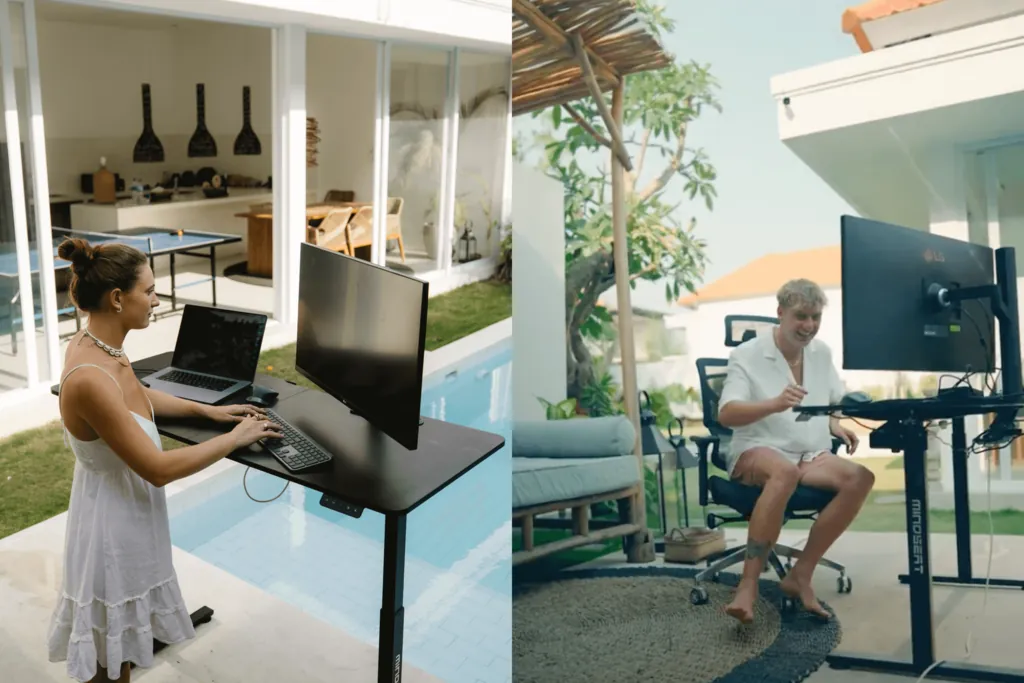
What no visa sorts out is the table. The villa was furnished for a holiday, and you'll spend more hours at that table than anywhere else on the island. A height-adjustable desk is $50 a month, an ergonomic chair $70, a 32-inch 4K monitor $160, or all three as The Best at $345. Delivered the same day, set up, and moved for free when your next extension sends you to a new villa.